Pre-production and during-production checks work only when they answer specific questions about an approved product and process. A factory visit without controlled criteria can produce observations but not a reliable release decision. Buyers should define the evidence, timing, sampling, limits, and authority before production begins.
Key takeaways
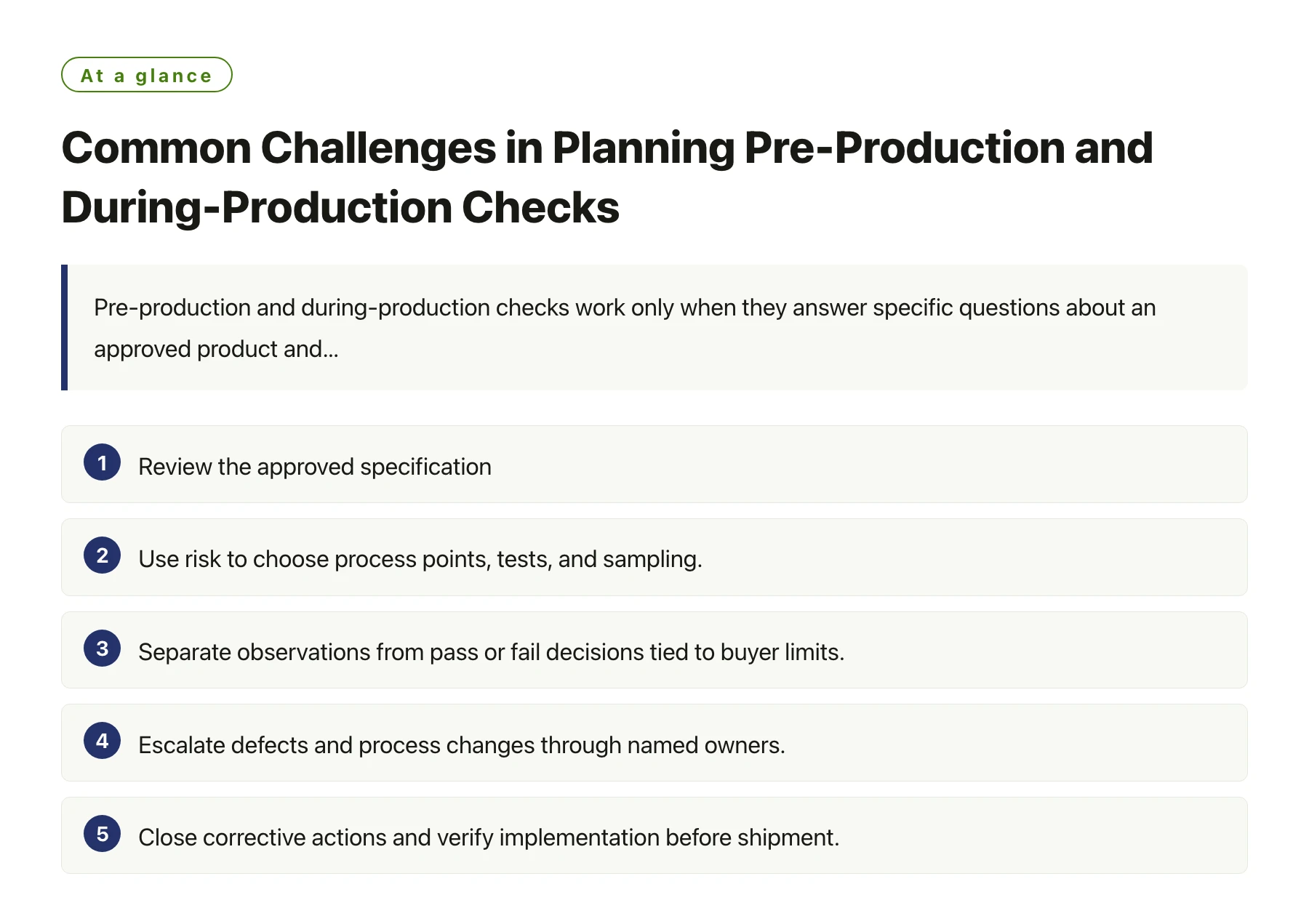
- Review the approved specification, sample, and production version before the first check.
- Use risk to choose process points, tests, and sampling.
- Separate observations from pass or fail decisions tied to buyer limits.
- Escalate defects and process changes through named owners.
- Close corrective actions and verify implementation before shipment.
Use a common room brief and product evidence matrix to compare supplier offers on the same basis.
1. Agree the product and inspection basis
Before a check, identify model, drawing revision, bill of materials, approved sample, quantity, lot, production site, and intended destination. Confirm that the supplier has the same controlled documents and can identify the goods being reviewed. A visit against an outdated sample creates false confidence.
Translate requirements into measurable limits, visual references, test methods, units, sample sizes, and defect classes. Distinguish mandatory safety or regulatory conditions from cosmetic preferences. Assign a technical owner to resolve any missing tolerance before inspection.
2. Decide what the pre-production check must establish
A readiness review can confirm that materials, components, tooling, work instructions, trained staff, calibrated equipment, packaging, labels, and inspection records are ready. Decide which evidence must be seen physically and which can be verified from controlled records. Keep the review tied to the specific product and order.
Check that the production plan identifies critical processes, outsourced steps, capacity assumptions, and hold points. Confirm first-off or pilot units will be available where needed and that deviations are documented rather than built into production informally.
3. Choose production checks by risk
During production, select stages where defects can still be prevented or contained: material receipt, setup, first-off, assembly, process settings, in-line testing, finishing, and packing. Focus on characteristics that affect safety, function, fit, compliance, or costly rework. Low-risk decorative details may need a different sample strategy.
Specify timing, lot definition, sample selection, test conditions, required access, and reporting deadline. A check performed after most goods are packed may detect defects too late to correct economically. Align the schedule with realistic production milestones, not a fixed calendar alone.
Before scheduling, confirm that production has reached the relevant stage and the inspector can access representative units and records. If dates slip, revise the check window and define whether goods must be held. The report should state the percentage or quantity complete so readers know what the observation represents.
4. Clarify sample and acceptance rules
State whether sampling is statistical, targeted, or 100 percent for selected critical features. Define the acceptance number, rejection rule, rework path, and whether a failed lot may be re-presented. Inspectors should not choose sample rules ad hoc after seeing a defect.
For a functional test, record setup, duration, cycles, instruments, results, and limits. For visual review, use controlled samples and viewing conditions. Keep inspected units linked to the lot and identify any destructive tests or samples that must be returned.
5. Make audit and quality-system evidence useful
ISO 9001:2026 specifies quality management system requirements for an organization; system certification does not determine product-specific acceptance criteria or prove a particular order conforms. Use system evidence to understand process control, then separately check the product and production records against the contract. [1]
Review records such as incoming checks, in-process results, nonconformance logs, equipment calibration, training, and traceability where relevant. Confirm the record belongs to the actual factory and product. Escalate missing or inconsistent evidence to the quality owner.
6. Report findings with clear decisions
A useful report states date, location, order, lot, sample, requirements checked, method, evidence, deviations, photos, and disposition. Separate observed facts from interpretation. Link every finding to a criterion and say whether it is pass, fail, pending, or not checked.
Assign corrective action, owner, deadline, containment, root cause, and verification method. Do not close a serious issue because a supplier promises improvement. Recheck the affected process or goods and record who accepted the final disposition.
7. Control changes and access limitations
If materials, factory, subcontractor, process, tooling, or design changes, pause and determine whether the approved check plan still applies. Record the change and needed revalidation. A production check on the former configuration cannot automatically cover a revised one.
Agree site access, protective equipment, photography, confidentiality, and production-safety rules beforehand. If access is limited, list what could not be verified and request alternative evidence or a follow-up. Report the limitation plainly rather than implying a complete check.
8. Connect checks to shipment release
Set release rules in advance: required checks complete, critical defects closed, documents present, labels and packing correct, deviations approved, and shipment quantity reconciled. Assign one release authority. An inspection report supports the decision but does not replace buyer approval or legal compliance review.
Buyers arranging China inspection services should provide a controlled order package and agree scope, timing, criteria, report format, and escalation contacts. After delivery, compare claims and receiving results with the pre-shipment record to improve future plans.
Sources
Frequently asked questions
When should pre-production checks happen?
Before mass production, after the product version, materials, tooling, instructions, and acceptance criteria are identified and available for review.
Can a during-production visit guarantee the final lot?
No. It samples conditions at a point in time. Define scope, lot, criteria, report limits, and any final inspection or release requirements.
Can ISO 9001 certification replace product inspection?
No. It concerns a quality management system. Product conformity still needs evidence against the order’s specific requirements.
What should happen after a critical defect?
Contain affected goods, document the finding, agree corrective action and owner, and verify the fix before the lot is released.