Reporting Problem Content: The Mechanics
Reporting on an adult platform is a two-route system, and knowing which route to use is most of the work. Every content page carries a report option for a specific listing, while the support address published on the site handles removal requests and compliance questions. The rest is what you write in the box: a short, factual report gets acted on, and a report that describes a feeling usually cannot be. Five minutes of precision is worth more than a page of complaint.

Key takeaways
- Two routes exist: the report option on the content page itself, and the support address the platform publishes for reporting and compliance.
- Three published pages define the process: the content removal policy, the complaints policy and the 2257 compliance statement.
- An actionable report names the listing, states which guideline is at issue, and gives the date you saw it.
- Cost is small: five minutes per report against an illustrative habit of 900 messages a month at 30 messages a day.
Two routes, two jobs
The in-page route is for a listing. Opening the report option from the page you are reading carries context with it, which is the single biggest factor in whether a report can be resolved without a follow-up question. Use it when something specific on a specific card or thread is the problem.
The email route is for everything else: account-level issues, a report that needs to carry attachments or screenshots of text, and any question about the platform's compliance position. The site publishes one address that serves both reporting and compliance contact, which means a well-written email can go straight to the right queue.
The distinction matters because the two routes reach different processes. A listing report is handled against the content guidelines. A compliance question may be handled against the 18 U.S.C. §2257 statement, which describes the content as AI-generated text that depicts no real person and confirms the service produces no images or video. Knowing which document your issue sits under is the difference between a report and a correspondence.
Writing a report that can be acted on
Four facts do the work. Name the listing or thread exactly as it appears. State the specific behaviour or text at issue rather than a general impression, because guidelines are written in specifics and a report has to map onto one of them. Give the date, since a listing may have changed since you saw it. And say what outcome you are asking for: review, or removal.
Two things belong outside a report. The first is speculation about who wrote something; the platform's content is AI-generated text and the author of a listing is a creator account, not a subject of investigation. The second is a description of how the content made you feel, which is understandable but not actionable. Keep the feeling out of the report and the report gets read faster.
One habit helps at the moment of writing: quote the text you are objecting to, briefly. A quoted line is verifiable, dated and unambiguous, and it removes the need for anyone to ask which part of a long thread you meant. A single sentence in quotation marks usually does more work than a paragraph of explanation.
Timing matters less than accuracy, but it still matters. A report written days later is still valid, because the removal policy applies to the catalogue rather than to your session, yet a report written the same evening carries context you would otherwise have to reconstruct from memory.
| Element | Weak version | Stronger version |
|---|---|---|
| Identification | "A card I saw somewhere" | The exact listing title and the page you found it on |
| Issue | "It was inappropriate" | The specific text or behaviour at issue |
| Timing | No date given | The date and approximate time you saw it |
| Outcome | Left unstated | A clear request for review or removal |
| Route | Sent by the wrong channel for the issue type | In-page report for listings, email for the rest |
Worked example
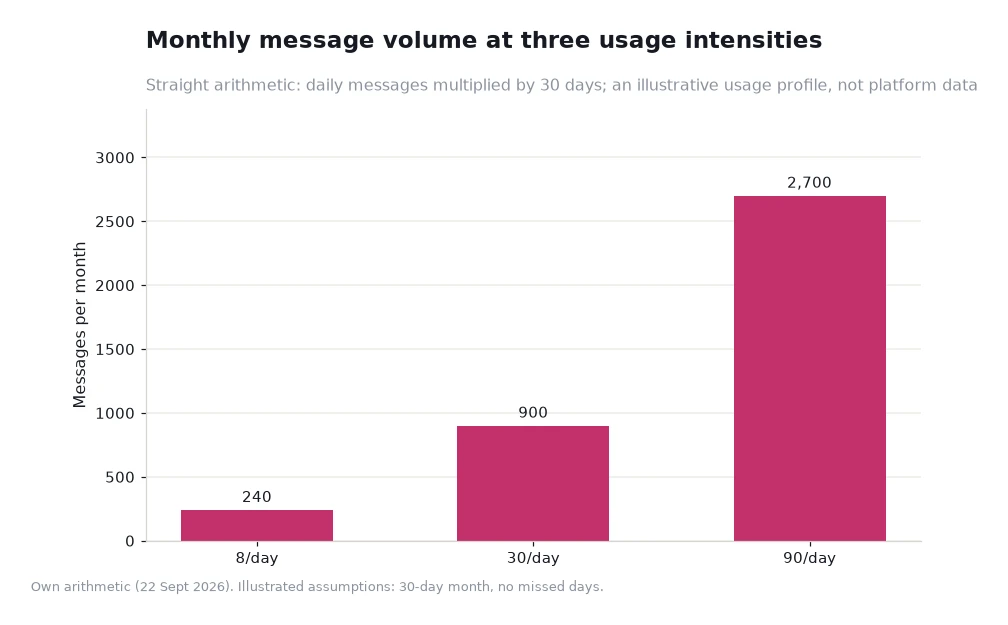
Put a cost on the process with illustrative figures, which are assumptions rather than platform data. Take a habit of 30 messages a day: 30 × 30 = 900 messages a month. Suppose that month contains one listing you want reviewed. Writing the report takes about five minutes; a follow-up email, if the first answer is unclear, takes perhaps ten.
Fifteen minutes against a month of use is roughly 0.03% of the time the platform occupied, if a heavy month runs to 60 hours. Even in a quieter month of 240 messages — 8 a day — the reporting cost stays the same, because it is fixed per incident rather than per message.
That asymmetry is the argument for reporting at all. The cost of the action does not scale with how much you use the platform, while the benefit to other readers does, since a single removal changes the slate everyone else sees.
What happens after you press send
It is worth being clear about what the process is not. It is not a moderation queue you can watch, and it is not a vote: one report does not automatically remove a listing. What it does is put a specific claim in front of people who can check it, which is why precision matters more than the volume of complaint.
The published process has two stages, and the second is the one people forget. Reporting is the first stage and it runs against the content removal policy. If the outcome does not resolve the issue, the complaints route exists for exactly that situation. Escalating is not complaining twice; it is moving to the documented second step, which is why the two processes have separate pages.
It helps to keep your own record: the date you reported, the wording you used and any reply you received. Three lines in a note file is enough, and it turns a stalled report into something you can follow up on precisely. The content removal policy and the complaints policy are both short, and reading them first usually answers the question that would otherwise have become the report.
One further point for anyone weighing whether to bother: the platform's own Porn Chat AI FAQ acknowledges that some limitations apply under its content and community guidelines, which means the guidelines are an active filter rather than a formality. A report is how that filter is fed. Anyone who wants to see what a community filter leaves behind can start from the ai porn chat overview page and work outward through Crushon's catalogue.
Frequently asked questions
Should I report or email?
Report from the page if the issue is a specific listing. Use the published support address for account questions, compliance matters, or anything needing attachments.
What should a report contain?
The listing title, the specific text or behaviour at issue, the date you saw it, and the outcome you want. Four facts, three sentences.
What if nothing happens?
Move to the complaints route, which is the documented second step, and include your original report date and wording.
Report precisely, then let it go
Use the in-page option for listings, email for everything else, and keep the four facts in your report. Then stop thinking about it: the process has a second stage for a reason.
Recording what you sent takes a minute and makes any follow-up trivial. This material is intended for adults of 18 and over.
Data and sources: content removal and complaints policy pages, the 2257 compliance statement and platform FAQ wording, read on 22 Sept 2026[1]. Message volumes and the fifteen-minute reporting cost are illustrative assumptions rather than platform data. Content is AI-generated text and depicts no real person. Adults 18+ only.