Heat Is a Hashrate Setting: How a Hot Room Stretches 445.8 Days
Two machines of the same model can take different amounts of time to reach the same coin target, because one of them is throttling. At 500 TH/s, 0.1 BTC takes about 445.8 days at the 21 Sept 2026 network figures. Let the same hardware settle at 475 TH/s through thermal throttling and the wait becomes 469.3 days. The difference is not the pool's fault, and no fee change will recover it.
Key takeaways
- At 500 TH/s the wait for 0.1 BTC is 445.8 days; at 1 PH/s it drops to 222.9 days.
- A 5% thermal derate at 500 TH/s adds roughly 23.5 days to that wait.
- Hashrate reported by firmware is a maximum, not a guarantee; the pool samples what actually arrives as shares.
- Compare a machine's 24-hour average against its clean-day average before blaming Pool Luck for a soft week.
The room decides part of your hashrate
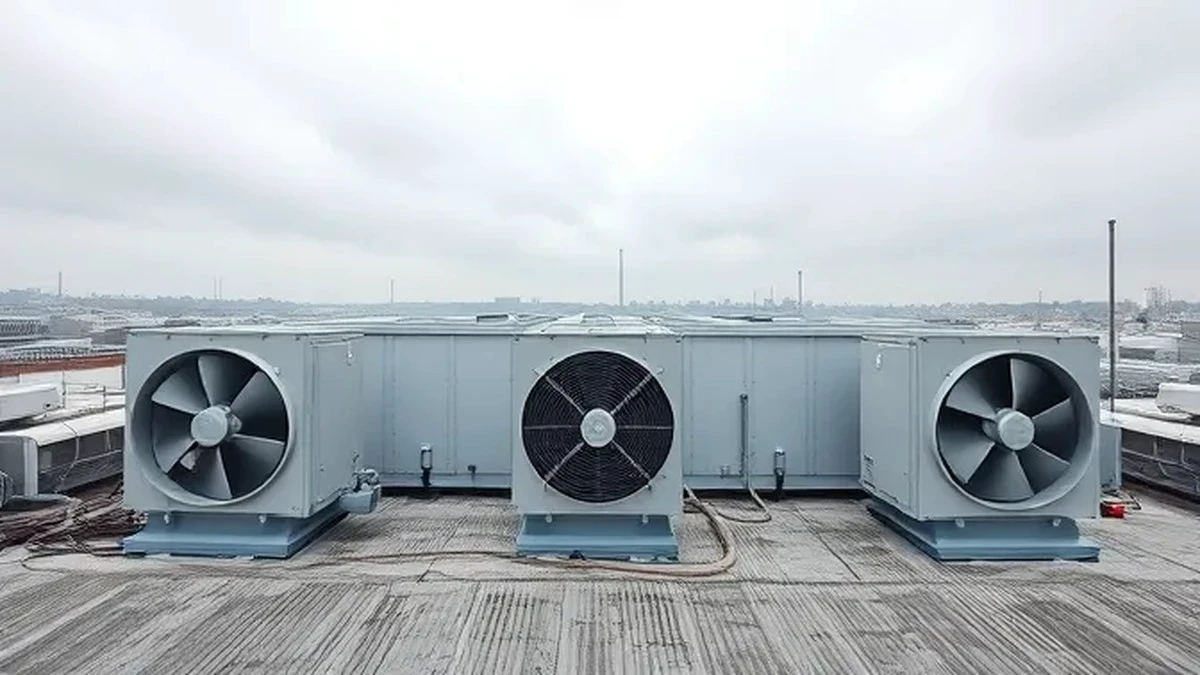
Firmware protects the silicon. When intake air warms past a threshold, the machine lowers its clock to keep junction temperatures inside limits, and the hashrate falls with the clock. The dashboard may still show the model name and the rated figure, while the share rate tells a different story. This is why two identical rigs in two buildings can report different 24-hour averages without either being broken.
The effect is easy to underestimate because it is gradual. A machine that runs 3% below its clean figure for a month looks fine on any single day and loses about a day of output across that month. In a hot season the loss compounds, and the annual average ends up below the number the buyer used for the original calculation.
What a five percent derate costs in days
The table holds everything constant except effective hashrate, so the extra days are attributable to the derate alone. Each row uses the same target, 0.1 BTC, and the same per-terahash rate of 0.0000004486 BTC a day.
| Effective hashrate | BTC per day | Days to 0.1 BTC | Extra days |
|---|---|---|---|
| 500 TH/s (clean) | 0.00022430 | 445.8 | 0 |
| 475 TH/s (−5%) | 0.00021309 | 469.3 | 23.5 |
| 450 TH/s (−10%) | 0.00020187 | 495.4 | 49.6 |
| 400 TH/s (−20%) | 0.00017944 | 557.3 | 111.5 |
Measure the derate before arguing about it
Pick a cool morning and record the reported hashrate over an hour. Then record it again at the hottest hour of the afternoon on the same day. The gap between the two is your derate, measured rather than guessed. Repeat on a second day to be sure it is a pattern and not a passing share-count fluctuation.
Once the number exists, it belongs in every later calculation. If the afternoon figure is 450 TH/s, then 450 is the hashrate you own in practice during that part of the day, and the calendar in this article should be read with the average of the two. A plan built on the morning figure alone will look better than the statements do.
Cheap instruments help here. A clamp meter on the feed and a thermometer at the intake cost less than a single fan replacement, and together they explain most of the variance an operator sees between the model number and the share count. Add the reading to the same note each day for a week; the pattern is usually obvious by Thursday.
It is also worth checking whether the derate is seasonal. A rig that is clean in March and 8% down in August has a cooling problem that can be planned for, not a hardware fault. Buying more hashrate to compensate for a summer derate is one way to solve it, and usually the most expensive one.
Worked example
Start from the clean case, then apply the derate the way a farm would experience it over a season.
- Per-terahash daily output: 450 ÷ 1,003,000,000 = 0.0000004486 BTC.
- 500 TH/s × 0.0000004486 = 0.00022430 BTC a day.
- 0.1 ÷ 0.00022430 = 445.85 days, shown as 445.8.
- Apply a 5% derate: 500 × 0.95 = 475 TH/s.
- 475 × 0.0000004486 = 0.00021309 BTC a day.
- 0.1 ÷ 0.00021309 = 469.28 days, which is 23.4 days longer — the chart's 23.5 after rounding.
- Over a full year, the derated machine produces 0.00021309 × 365 = 0.077778 BTC against 0.081870 BTC clean, a shortfall of 0.004092 BTC, or about $346 at $84,692.
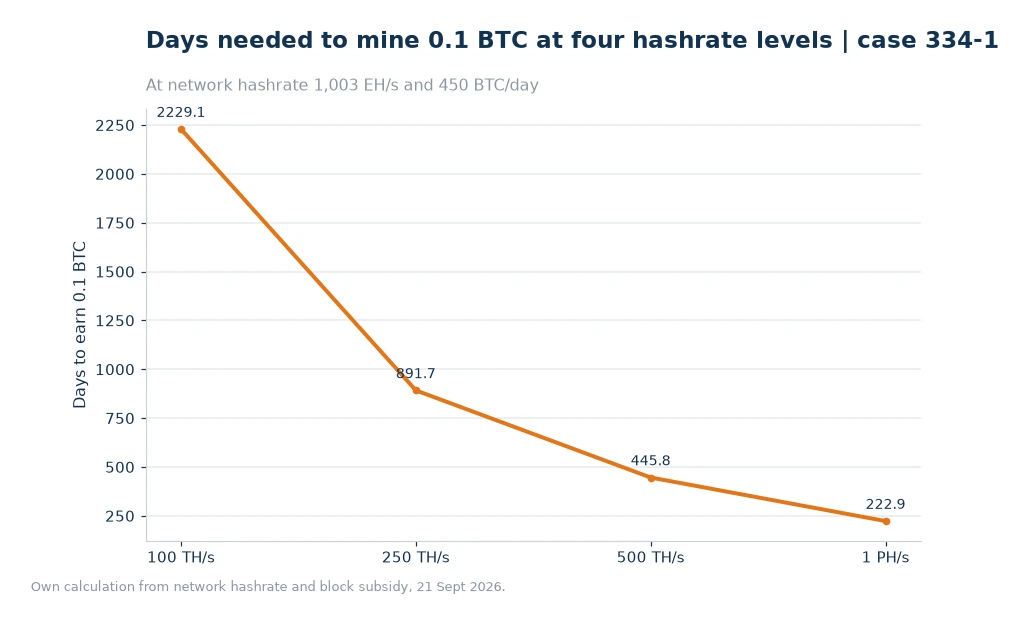
Why the curve punishes a hot farm twice
The first punishment is the missing hashrate, which stretches every timeline on this page. The second is that cooling itself draws power, and that power is billed whether or not the machine is at full clock. A farm running fans harder to hold a temperature is paying more per terahash at exactly the moment it is producing fewer of them.
That combination is why site design shows up in payout figures even though the pool never sees a thermometer. Two operators with identical hardware and identical tariffs can have different margins because one of them put the intake on the shaded side of the building. The pool pays shares; the building decides how many shares exist.
There is a counter-intuitive detail in the arithmetic: the days lost to a derate are not proportional to the derate itself. A 20% derate adds 111.5 days to a 445.8-day target, which is 25% more waiting, because the target is divided by a smaller daily figure. Small derates produce slightly larger time penalties than the percentage suggests, and that asymmetry is easy to miss when the only number being watched is the hashrate dial.
Separating Pool Luck from a hot board
A soft week has several possible causes, and they are distinguishable. Pool Luck moves a PPLNS payment up or down with the pool's block finds, and it affects every miner in the window at once. A hot board affects one machine, and it shows up as a lower reported hashrate rather than a lower share value. Check the reported hashrate first; it is the cheaper test.
The ViaBTC Pool Hashrate page gives the pool and network context for that comparison, so a single machine's dip can be judged against whether the whole pool moved. If the pool is steady and your rig is down 6%, the answer is in the room, not in the scheme.
Frequently asked questions
Does throttling change the coins I am owed?
Yes, because payment follows delivered shares: at 475 TH/s effective you earn 0.00021309 BTC a day rather than the 0.00022430 BTC a day a clean 500 TH/s machine produces.
How much time does a 10% derate add?
About 49.6 days on a 0.1 BTC target: 445.8 days clean becomes 495.4 days at 450 TH/s effective, with everything else held constant.
Can a lower fee offset a hot room?
Only slightly. The listed rates differ by a couple of percentage points between schemes, while a 20% derate adds 111.5 days to the same target, so cooling is the larger lever.
Cool first, then buy hashrate
Before adding machines, spend an afternoon on airflow: clear the intake, separate the hot aisle from the cold, and check that the exhaust is not feeding the next row. The gain from fixing a bad layout is often larger than the gain from a fee change, and it costs nothing but time. Then re-measure the 24-hour average and rebuild the calendar with the real number.
If the machines live somewhere else, the Mining Farms listings are a way to compare hosting arrangements, and the ViaBTC App will alert on a hashrate drop while it is still a small problem. Temperature is not visible in either place, which is exactly why the number has to be measured at the machine.
Sources: ViaBTC pool state, farms and app pages; network figures read 21 Sept 2026 — hashrate about 1,003 EH/s, difficulty 132.76 T, 3.125 BTC per block, 144 blocks a day, BTC $84,692. Published 24 Oct 2026. Derate scenarios are arithmetic assumptions, not measurements of any specific model[1].