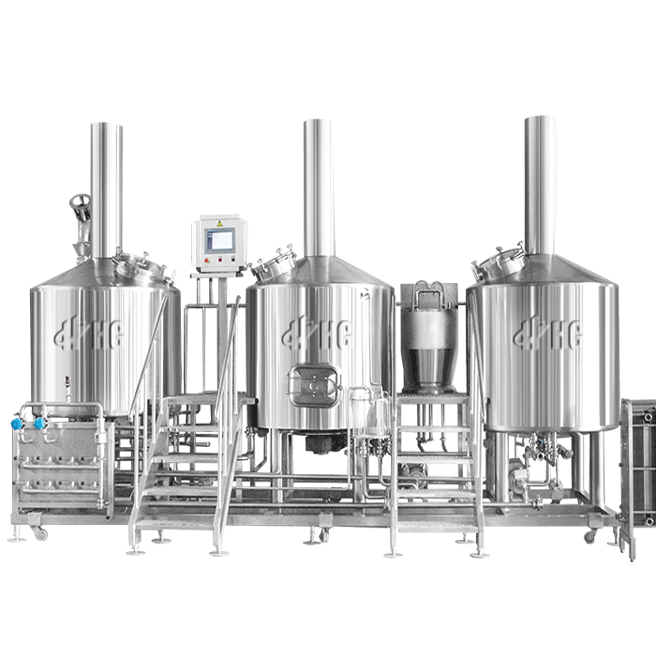
A modern brewhouse normally includes grain handling, a mill, mash and lauter equipment, a kettle, whirlpool, hot-liquor storage, sanitary pumps, valves, a plate heat exchanger, instrumentation, controls, and CIP hardware. A 10 BBL commercial system may use roughly 1,170 L as its nominal batch reference, while real vessel capacity is often larger to provide headspace. Commercial examples pair a 10 BBL brewhouse with a 20 BBL hot liquor tank, 3 sanitary pumps, variable-frequency drives, temperature controls, and a wort heat exchanger. Vessel count alone does not define production capacity: heating rate, lautering area, transfer speed, cleaning time, and brewhouse efficiency determine how many batches can actually be completed. The Brewers Association noted in 2026 that raising extract efficiency by 10% can, depending on the beer, save about one 50 lb bag of malt in a 7 BBL batch.
Commercial brewing starts at the mill because the physical condition of the grist affects everything that follows. A two-roller mill is common at smaller breweries, while higher-throughput plants may use four- or six-roller designs with tighter control over husk, grits, and flour. The goal is enough endosperm exposure for extraction without destroying the husk structure needed for wort filtration. A brewery consistently operating below 80% extract efficiency has measurable room for improvement, according to Brewers Association guidance published in 2026.
Milled grain normally passes through an auger or other conveying equipment into a grist case above the mash vessel. A grist hydrator can wet the malt as it enters, reducing dry pockets and shortening manual mixing. Commercial 10 BBL equipment lists commonly include the hydrator as part of the brewhouse rather than treating it as an optional accessory; one documented 10 BBL installation also specifies a 4-inch valve at the hydrator.
Milling capacity should be matched to mash-in time rather than annual beer volume alone. A mill that takes 45 minutes to prepare every grist bill can extend a brew day even when the vessels themselves have unused capacity.
Once hydrated grain enters the mash vessel, temperature control becomes the main equipment requirement. Commercial mash tuns generally use 304 stainless steel, insulation, an agitator, temperature measurement, sanitary spray devices, and either steam jackets or electric heating. One current 10 BBL specification lists 2.7 m² of heating area and a total vessel volume of 12.5 BBL for a 10 BBL effective volume, leaving roughly 20% above the stated working capacity.
The extra space matters during mixing and heating, but vessel geometry matters again when mash separation begins. In a combined mash/lauter vessel, a slotted false bottom holds the grain while wort drains through it. Dedicated lauter tuns add rake assemblies, wort collection points, sparging hardware, differential-pressure measurement, and spent-grain discharge. Runoff must remain slow enough to avoid compacting the grain bed while still fitting the production schedule.
| Equipment | Typical job | Specification worth checking |
|---|---|---|
| Malt mill | Crush malt | Roller gap, kg/h throughput |
| Mash tun | Mix and convert starch | Working volume, heating area |
| Lauter tun | Separate wort from grain | False-bottom area, rake control |
| Kettle | Boil wort | Heating power, evaporation performance |
| Whirlpool | Remove trub | Diameter, inlet geometry |
| HLT | Store hot brewing liquor | Usable volume, recovery rate |
| Heat exchanger | Cool wort | L/h capacity, inlet temperatures |
| Pumps | Transfer liquids | Flow, head, VFD control |
Lautering performance also changes raw-material use. The Brewers Association reported in 2026 that a 10% improvement in extract efficiency can produce a broadly similar reduction in malt requirement under suitable recipe conditions. For a 7 BBL example, that improvement could remove one 50 lb bag from a batch, so mill adjustment, grain-bed depth, runoff control, and accurate wort measurements deserve attention before simply adding more malt.
After separation, wort enters the kettle, where heating equipment must raise a large liquid mass to boiling temperature without scorching it. Steam jackets are common in commercial systems because several jacket zones can distribute heat across the bottom and lower sidewall. A documented 10 BBL steam kettle uses 3 welded steam jackets, while another 10 BBL commercial system recommends a 10–15 HP steam generator.
Boiling stops enzymatic activity, sanitizes wort, supports hop utilization, removes volatile compounds, and concentrates extract as water evaporates. The vessel therefore needs working headspace rather than being filled to its geometric limit. Heating capacity should also be specified around the required time to reach boiling; shaving 15 minutes from each heat-up becomes material when a brewery runs several turns in a single production day.
That timing requirement explains why larger brewhouses separate vessels that smaller breweries combine. A two-vessel arrangement often uses a mash/lauter tun plus a kettle/whirlpool. Three- and four-vessel layouts separate more operations, allowing one batch to enter the next stage while another is still being processed. A commercial 10 BBL two-vessel configuration may be rated for approximately 6–12 brews per week, although actual output depends on recipes, labor, utilities, and cellar availability.
Adding another vessel does not automatically change beer quality. It changes scheduling: separating the whirlpool from the kettle can release the kettle earlier, while separating mash and lauter operations can allow preparation of the next batch before the previous runoff is finished.
The whirlpool receives hot wort after boiling and uses tangential flow to concentrate hop material and coagulated protein near the vessel center. Its useful specifications include vessel diameter, liquid depth, inlet position, pump flow, settling time, and wort outlet height. A compact Beer brewery system may combine kettle and whirlpool functions where floor space and batch frequency make a separate vessel unnecessary.
The next equipment group handles water, which moves through the brewhouse in much larger quantities than the packaged beer alone suggests. A hot liquor tank supplies strike water, sparge water, vessel preheating, and other hot-water demand. Current 10 BBL commercial configurations commonly pair the brewhouse with a 20 BBL HLT, providing about twice the nominal batch volume; another equipment specification uses hot-water storage at roughly 2–3 times brewhouse size.
Cold liquor storage becomes useful when municipal or well water is too warm for fast wort cooling. Brewers Association water guidance documents a case in which cold-liquor temperature rose from 12°C to 20°C during hot weather; together with an outdated exchanger, that temperature increase reduced cooling performance. Cooling design therefore needs actual summer inlet-water conditions rather than an annual average.
A plate heat exchanger sits between the hot side and fermentation side of the process. Thin stainless plates create separate channels for wort and cooling media, producing a large heat-transfer surface in a small footprint. One commercial 10 BBL equipment configuration specifies a plate heat exchanger rated at 40 hL/h, enough nominal flow to move 10 hL in about 15 minutes before allowances for operating conditions and piping restrictions.
Engineering calculations show why exchanger sizing cannot be based on batch volume alone. A published brewhouse calculation uses 107 hL of wort flowing at 49 hL/h, heated from 74°C to 92°C before the kettle; the calculated exchanger duty is 110 kW with an 11.1 m² heat-transfer area before adding a safety margin. The same engineering principle applies in reverse during wort cooling: inlet temperatures, required outlet temperature, flow and heat-transfer coefficient all affect exchanger size.
Cooling also creates an opportunity to recover heat. Water leaving the wort exchanger can be routed to hot-water storage instead of immediately entering the drain, provided temperature and water quality suit the brewery's process. In a plant making several batches per day, recovered hot water reduces how much energy the boiler or electric heaters must supply before the following mash.
Moving all those liquids requires sanitary pumps and correctly sized piping. Centrifugal pumps are commonly used for wort, brewing liquor, transfers, and CIP circulation; variable-frequency drives allow the same pump to operate at different speeds during mash transfer, vorlauf, sparging, whirlpool circulation, and knockout. A documented 10 BBL system includes 2 sanitary pumps with 2 HP/1.5 kW stainless motors, while another commercial design uses 3 sanitary pumps.
Piping design then determines whether pump capacity is usable. Long pipe runs, unnecessary elbows, undersized tubing, restrictive valves, and elevation changes add pressure loss. Sanitary layouts also need drainable lines and limited dead legs because wort residues contain carbohydrates and proteins that support microbial growth. Tri-clamp fittings remain common on smaller installations because sections can be inspected and serviced without permanently cutting welded pipe.
Valve selection becomes more important as automation increases. Manual butterfly valves are adequate for many small breweries, while pneumatic valves allow a PLC to route water and wort automatically. A current 10 BBL commercial specification includes DIN40 pneumatic valves across its process arrangement, showing how automation can extend beyond temperature control into actual fluid routing.
Instrumentation supplies the information needed to control those valves and pumps. RTDs or other temperature sensors measure mash, liquor, and kettle conditions; flow meters measure mash-in and sparge water; level sensors protect tanks from overfilling; pressure measurement can help operators assess vessel and filtration conditions. One documented 10 BBL installation includes a digital flow meter for mash and sparge water, RTD measurement, conductivity-based HLT level control, and VFD-controlled pumps.
A PLC/HMI system can place temperature setpoints, timers, pump speeds, valve states, and recipe steps on one interface. Automation is most useful where repetition matters: holding a mash rest, metering a fixed liquor volume, controlling a pump, or recording temperatures. In 2026, the Brewers Association continued to publish tools for tracking brewhouse efficiency across batches, reinforcing the usefulness of consistent measurement rather than relying only on operator impressions.
Cleaning equipment completes the process loop because every product-contact surface must be cleaned between production cycles. Spray devices in vessels, CIP supply and return piping, chemical tanks, pumps, and conductivity measurement can form a dedicated clean-in-place system. A smaller brewery may prepare cleaning solution in an existing vessel, while a larger plant can use separate caustic, acid, rinse-water, and recovery tanks.
CIP pump selection is based on the flow and pressure required by the spray device and piping circuit, not simply on vessel capacity. A 20 BBL tank with poor spray coverage can take longer to clean than a larger vessel supplied by a correctly sized CIP circuit.
Utilities should therefore be reviewed at the same time as the stainless equipment. Steam-fired brewhouses require a boiler or steam generator, pressure regulation, condensate handling, and insulated steam piping; electrically heated systems require enough available service capacity. Published 10 BBL systems illustrate the range: one lists 15–70 kW depending on configuration, while steam-fired 10 BBL equipment can specify approximately 10–15 HP of steam generation.
Compressed air is added when pneumatic valves are used, and glycol refrigeration becomes important once wort enters fermentation equipment. Fermenters, bright tanks, kegging or canning machines, and cold storage are generally outside the brewhouse itself, but their capacity still has to match it. Producing 2 × 10 BBL batches in a day offers little operational benefit when only one 10 BBL fermenter is available.
For that reason, equipment comparison works better when buyers examine throughput rather than vessel labels. A nominal 10 BBL vessel corresponds to roughly 1,170 L, but finished volume will be lower after evaporation, trub retention, piping hold-up, fermentation losses, and packaging losses. Manufacturers may also use nominal capacity, total vessel capacity, or working capacity differently, so those figures should be separated on the specification sheet.
The same comparison should cover fabrication and service details: 304 versus 316 stainless in selected areas, internal finish, insulation thickness, weld treatment, jacket pressure rating, pump manufacturer, motor power, valve type, electrical standard, spare-parts availability, drawings, manuals, commissioning, and control components. One 10 BBL commercial example specifies 2-inch mineral-wool insulation, T-304 stainless construction, TIG-welded assemblies, and 3 steam jackets on the kettle.
Brewhouse efficiency belongs on that specification list as a measured production figure rather than a sales claim. The Brewers Association defines it around the extract recovered in wort compared with extract available from malt, expressed as a percentage, and its 2026 guidance identifies operations below 80% as having substantial potential for improvement. Accurate volume and gravity measurement are needed before comparing batches.
A practical purchase specification can therefore record working batch volume, maximum grain bill, expected extract efficiency, heating time, lauter time, knockout time, HLT recovery, exchanger flow, pump curves, CIP requirements, utility demand, and expected turns per day. If a brewery expects production to rise by 50% within several years, space for another vessel, additional cellar tanks, larger utilities, or future automated valves can be planned before installation rather than rebuilt later.
A modern brewhouse is best specified as one connected process. Mill throughput affects mash-in time; mash and lauter geometry affect extract recovery; heating capacity affects cycle time; whirlpool and exchanger sizing affect knockout; pumps and piping affect every transfer; CIP affects the interval before the next batch. A 2026 production plan based on measured flow, temperature, volume, efficiency, and cycle time provides more useful information than choosing equipment from BBL capacity alone.